
Let me tell you, I'm a supplier of 3D puzzles, and I've seen firsthand how these little wonders can capture people's imaginations. But one question I get a lot is, "Do 3D puzzles have a learning curve?" Well, let's dive right in and find out.

First off, what exactly are 3D puzzles? They're not your regular flat jigsaw puzzles. These are like mini construction projects. You've got pieces that fit together to create a three - dimensional object. We've got 3D Puzzle Airplane Model, which is a hit with aviation enthusiasts. It's amazing to watch as you start with a bunch of parts and end up with a cool airplane on your desk.
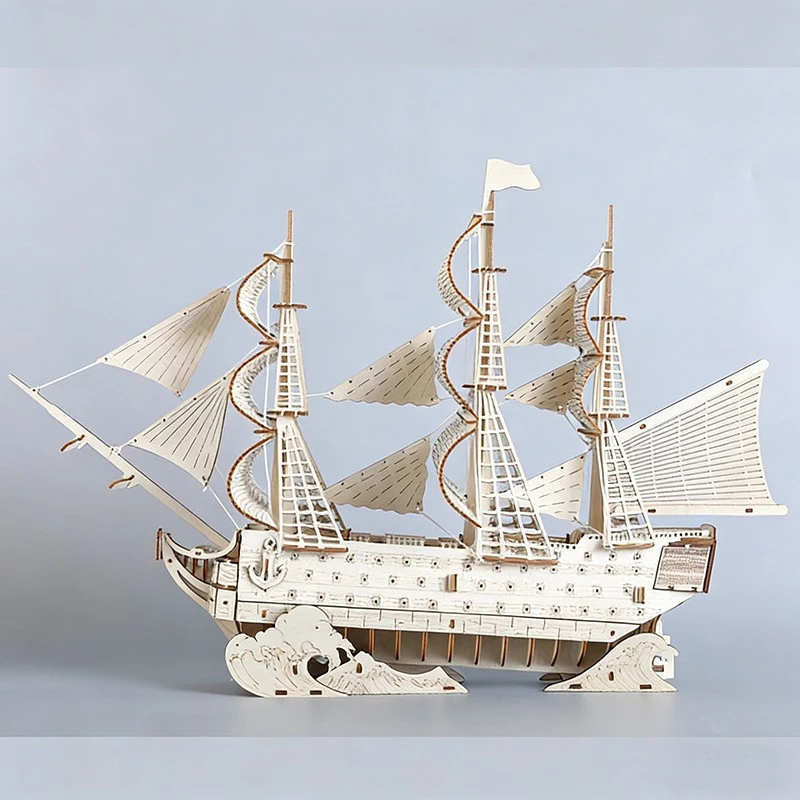
And then there's the 3D Wooden Ship Puzzle. Building this is like taking a journey back in time. The detailed pieces and the final product that looks like a real - life ship in a bottle. It makes you feel like a real shipbuilder.
Now, back to the learning curve question. For beginners, there's definitely a bit of a learning process. When you first open a 3D puzzle box, it can be a bit overwhelming. There are so many pieces, and it's not always clear where to start. It's like standing in front of a big, complicated Lego set. But here's the good news: it's not as hard as it seems.
Most 3D puzzles come with instructions. And in today's digital age, you can usually find online tutorials too. The first step in overcoming the learning curve is to read the instructions carefully. They'll give you a general idea of how the puzzle is supposed to come together. I remember when I first tried a World Famous Architecture 3D Puzzle. The instructions showed me the basic structure, and that was a huge help.
Another thing that helps is to start with simpler puzzles. If you're brand new to 3D puzzles, don't jump straight into a super - complex one. There are some beginner - friendly puzzles that have fewer pieces and a more straightforward assembly process. For example, our 3D Space Rocket Puzzle is great for newbies. It has a clear structure, and you can assemble it in a relatively short time.
As you work on more puzzles, you start to pick up on some tricks. You learn how to identify the different types of pieces, like the ones for the base, the ones for the sides, and so on. You also get better at visualizing how the final product will look as you're putting it together.
Once you've got the hang of the basics, more complex puzzles become a lot easier. For instance, a Creative 3D House Puzzle might seem intimidating at first, but with the skills you've learned from simpler puzzles, you'll be surprised at how quickly you can start making progress.
One of the most important things to keep in mind is patience. Rome wasn't built in a day, and neither is a 3D puzzle. There will be times when you're frustrated because a piece doesn't seem to fit, but that's all part of the process. Take a break, come back to it later, and you'll often find that it just clicks into place.
Another aspect is the cognitive benefits that come with overcoming the learning curve. 3D puzzles are great for improving your problem - solving skills. You have to figure out how to fit the pieces together, which requires a bit of logical thinking. They also boost your spatial awareness. You're working in three dimensions, so you need to understand how the pieces relate to each other in space.
And let's not forget about the sense of accomplishment. When you finally finish a 3D puzzle, especially a challenging one, it gives you a real feeling of pride. You look at the finished product and think, "I built that." It's a great confidence - booster.
From a business perspective, as a 3D puzzle supplier, I've noticed that people who once found 3D puzzles difficult are now asking for more complex ones. That shows that the learning curve is not something to be feared. It's a stepping - stone to a whole new world of puzzle - building fun.
If you're thinking about getting into 3D puzzles, whether you're a beginner or looking to up your game, I encourage you to give it a try. And if you're a retailer or someone interested in purchasing our puzzles in bulk, we're here to talk. We've got a wide range of 3D puzzles to suit different skill levels and interests. Just reach out, and we can start a conversation about how we can meet your needs.
References:
- "The Psychology of Puzzle - Solving", Journal of Cognitive Hobbies
- "Benefits of 3D Puzzle Building", Toy Industry Insights Magazine