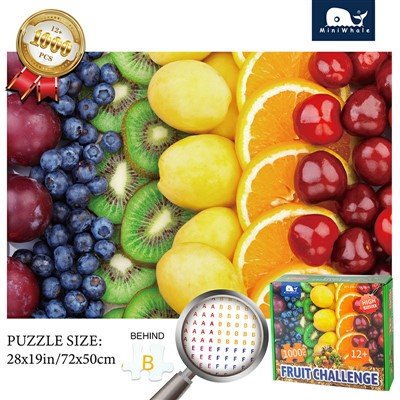
Develop your baby's listening, speaking, and reading skills. While playing with puzzles, children learn how to solve them from the instructions, and their listening and speaking abilities are fully developed when playing with parents or other children.
Develop your baby's problem-solving skills. Educational experts believe that fine motor skills begin with games that children enjoy. If children don't receive training between the ages of 3 and 8, they miss this crucial period, and children who haven't received this training will lag behind in fine motor skills later in life. Even if a child has learned a lot or achieved high test scores, success will be very difficult and unlikely if their fine motor skills are poor. In the process of doing puzzles, besides developing the baby's upper arm muscles and hand-eye coordination, the most important thing is that puzzles require the baby to solve problems independently and ultimately succeed through repeated attempts and failures. This process is a valuable experience for building a baby's confidence and abilities.
Puzzles can improve a baby's observation skills. Observation is an important way for people to perceive the outside world and acquire knowledge. For children, discovering the specific location of each puzzle piece requires careful observation. The variety of puzzles helps babies learn colors, letters, numbers, and shapes, and understand the relationship between the whole and its parts, thus unconsciously developing their mathematical abilities.
They also foster teamwork. Babies can work on large puzzles with parents or other children, each responsible for a part, cultivating teamwork skills. Through cooperation, babies learn how to interact and communicate with others, how to obey orders, how to express their own opinions, and understand the importance of working together. Good interpersonal relationships and teamwork are the foundation for respect and success.
Furthermore, they cultivate the habit of tidying up. Before each puzzle, let the baby find and put away the pieces themselves; after each puzzle, require the baby to put them back in their designated place, fostering a good habit of finishing what they start.
Puzzles can develop a baby's thinking skills. While assembling, babies will try various methods, attempting different solutions if one doesn't work. This gradually expands their thinking. When unsure if a puzzle can be completed, they will explore different approaches. When babies put things together, they not only use their brains but also their hands, which is beneficial to their physical and mental health.