
Spatial awareness is like a super - power in our daily lives. It helps us understand how objects are positioned in space, how they interact with each other, and how we can move around them. Whether it's packing a suitcase, parking a car, or playing sports, having good spatial awareness is key. And guess what? Educational puzzles are one of the coolest and most effective ways to boost this skill. As a supplier of educational puzzles, I've seen firsthand how these puzzles work wonders for spatial awareness. Let me break it down for you.
First off, let's talk about the basics. When kids (or adults, for that matter) start working on a puzzle, they're immediately thrown into a world of shapes, sizes, and orientations. Take the Double - Sided Cartoon World Map Puzzle, for example. This puzzle has pieces of various irregular shapes that need to fit together to form a complete map. When you pick up a puzzle piece, you have to look at its edges, figure out what kind of shape it is, and then visualize where it might fit in the overall picture. This process of analyzing the shape and orientation of individual pieces is a great way to train your brain to understand spatial relationships.
You see, our brains are constantly making sense of the world around us by creating mental maps. When we work on puzzles, we're essentially building and refining these mental maps. We're learning to recognize patterns, understand how different parts fit into a whole, and make predictions about what comes next. It's like a mental workout for our spatial awareness muscles.
Another aspect of spatial awareness that puzzles help with is depth perception. Depth perception allows us to judge the distance between objects and understand their three - dimensional nature. The Glow - in - the - Dark Ocean Shark Puzzle is a great example here. The design of this puzzle might use shading, perspective, and different levels of detail to create a sense of depth. As you're trying to put the pieces together, you need to understand how the different parts of the shark's body or the ocean scene relate to each other in terms of depth. This helps improve your ability to perceive depth in real - life situations as well.
When you're assembling a puzzle, you also have to think about scale. Scale is all about understanding the relative size of objects. The Giant Double - Sided Solar System Puzzle is huge and shows the planets in a somewhat proportional size. Working on this puzzle, you get a better sense of how big the different planets are compared to each other. You start to understand that Jupiter is much larger than Earth and that the distances between the planets are vast. This understanding of scale is crucial for spatial awareness, as it helps us make sense of the world's size and proportion.
Educational puzzles also encourage problem - solving skills, which are closely linked to spatial awareness. When you're faced with a difficult puzzle, like the Observation Puzzle Set, you have to think outside the box. You might try different strategies to fit the pieces together, such as starting with the edges or grouping similar - looking pieces. This trial - and - error process involves visualizing different solutions and thinking about how the pieces can be manipulated in space. It's like solving a real - life spatial problem, and it helps strengthen your ability to approach and solve other spatial challenges.
For younger learners, the Early Learning Educational Puzzle is a fantastic way to introduce the concept of spatial awareness. These puzzles are designed with simple shapes and bright colors, making it easy for kids to grasp the basic idea of fitting pieces together. As they progress from easy to more complex puzzles, their spatial awareness skills gradually improve. They learn to turn, rotate, and flip pieces to get them to fit, which is a great way to develop fine - motor skills and spatial understanding at the same time.
From a developmental perspective, working on puzzles at an early age can have long - term benefits. Research has shown that children with good spatial awareness tend to perform better in subjects like math and science. Math often involves understanding shapes, numbers in space, and geometric concepts, all of which are related to spatial skills. Science, especially fields like physics and astronomy, also requires a good understanding of how objects move and interact in space.
Moreover, educational puzzles are not just for kids. Adults can also benefit from them. If you're in a job that requires spatial thinking, like architecture, engineering, or graphic design, puzzles can be a fun way to keep your spatial skills sharp. They can also be a great stress - reliever, as they allow you to focus on a task and get lost in the process of solving it.
In addition to the direct benefits for spatial awareness, educational puzzles also offer other perks. They can improve concentration, patience, and hand - eye coordination. When you're working on a puzzle, you need to focus on the task at hand, be patient as you search for the right pieces, and use your hands to pick up and place the pieces in the correct position.
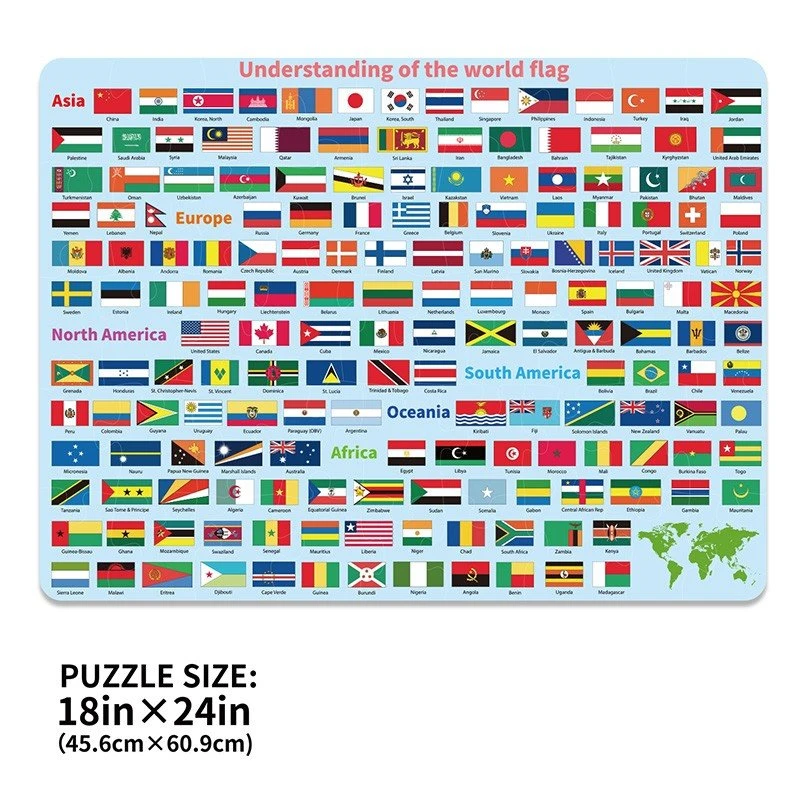

As a supplier of educational puzzles, I'm passionate about providing high - quality products that not only entertain but also educate. Our puzzles are designed with the latest research in mind, ensuring that they are effective in developing spatial awareness and other cognitive skills. We use durable materials, bright colors, and engaging designs to make the puzzle - solving experience as enjoyable as possible.
If you're a parent looking to give your child a head - start in learning, a teacher searching for effective educational tools, or a business interested in bulk purchases, we'd love to hear from you. These puzzles are a great investment in the development of spatial awareness and other important skills. Don't hesitate to reach out if you have any questions or want to discuss your purchasing needs.
References
- Casey, M. B., Nuttall, R. L., & Pezaris, E. (1997). Mediators of sex differences in mathematics college entrance test scores: A comparison of spatial skills with internalized beliefs and anxieties. Developmental Psychology, 33(3), 669 - 680.
- Mix, K. S., Levine, S. C., & Huttenlocher, J. (1997). Spatial transformation abilities in 2 1/2 - and 3 - year - olds. Developmental Psychology, 33(2), 347 - 356.